
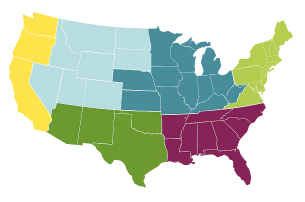
How do we use your location?
Knowing your location helps us recommend plants that will thrive in your climate, based on your Growing Zone.
| Buy More, Save More | Bulk Discount |
|---|
* There is a 1 packet minimum required for this item.
Easy! Easy! Why everybody loves Zinnias: Probably no plant can give you more color for less work. It's because the zinnia is one of the easiest plants to grow from seed (any child can do it, and many do!), they'll give you every color but blue, and they bloom all season up until frost. Can you think of another flower that does all that?
How to grow them: Good full sun is really all that's required, although some of the newer hybrids will even bloom in partial shade. As for water, they don't need much, since they're from hot desert-like habitats. Soil? Almost any soil will do, but they prefer fast-draining gritty soil, if you have that available.
Zinnia seeds are perfect for starting indoors to have bloom early. But be sure you wait until every frost is gone, and the soil has warmed up a bit before setting them out. They're super-sensitive to frost--after all, these plants are from frost-free regions, and don't like cold soil. If you'd rather, you can just wait until spring arrives, and sow them outside. They're very undemanding.
The Wildflower that's been all dressed up for years. There about 20 species of Zinnia in the wild, all in the arid, rocky soils of North, Central and South America, most common in Mexico. If you saw the wild plants, you'd be amazed, since Zinnias are one of our most heavily-hybridized wildflowers, and the somewhat "ragged" originals look nothing like our garden beauties. That's because hybridizers discovered them early, and have been "working on them" for decades.
The Wild Ones The most commonly hybridized species is Zinnia elegans, a common wild plant in Mexico. But in recent years, work has been done on some of the other species. Like the dahlia (also from Mexico) the Zinnia takes quickly and willingly to almost anything the hybridizers want to do: Taller, shorter, or bigger flowers. Multi-colored flowers. You name it, and they seem to be able to do it to Zinnias.
Because of that, these flowers have been staples among major color-makers in gardens since your great-grandmother's time, and more and more beautiful zinnias are created for our gardens almost every year.
Easy! Easy! Why everybody loves Zinnias: Probably no plant can give you more color for less work. It's because the zinnia is one of the easiest plants to grow from seed (any child can do it, and many do!), they'll give you every color but blue, and they bloom all season up until frost. Can you think of another flower that does all that?
How to grow them: Good full sun is really all that's required, although some of the newer hybrids will even bloom in partial shade. As for water, they don't need much, since they're from hot desert-like habitats. Soil? Almost any soil will do, but they prefer fast-draining gritty soil, if you have that available.
Zinnia seeds are perfect for starting indoors to have bloom early. But be sure you wait until every frost is gone, and the soil has warmed up a bit before setting them out. They're super-sensitive to frost--after all, these plants are from frost-free regions, and don't like cold soil. If you'd rather, you can just wait until spring arrives, and sow them outside. They're very undemanding.
The Wildflower that's been all dressed up for years. There about 20 species of Zinnia in the wild, all in the arid, rocky soils of North, Central and South America, most common in Mexico. If you saw the wild plants, you'd be amazed, since Zinnias are one of our most heavily-hybridized wildflowers, and the somewhat "ragged" originals look nothing like our garden beauties. That's because hybridizers discovered them early, and have been "working on them" for decades.
The Wild Ones The most commonly hybridized species is Zinnia elegans, a common wild plant in Mexico. But in recent years, work has been done on some of the other species. Like the dahlia (also from Mexico) the Zinnia takes quickly and willingly to almost anything the hybridizers want to do: Taller, shorter, or bigger flowers. Multi-colored flowers. You name it, and they seem to be able to do it to Zinnias.
Because of that, these flowers have been staples among major color-makers in gardens since your great-grandmother's time, and more and more beautiful zinnias are created for our gardens almost every year.
As soon as your order is placed you will receive a confirmation email. You will receive a second email the day your order ships telling you how it has been sent. Depending upon your order date, we may hold your shipment to combine it with other products on your order, if applicable. See our shipping information page for approximate ship dates and more detailed information. If you have any questions, please call Customer Service toll-free at (802) 227-7200 or contact us by email or chat.

Overall rating: 4.285714 / 5 from 7 reviews.
Review topics: [].
"Get ready for compliments! We have a difficult time getting flowers to grow by the driveway and curb areas but this Will Roger bright red is a stunning and hearty flower to have growing by the front of the home and driveway!!! The bees and butterflies flock to this flower too, especially in the fall when all other flowers are dying back. Will plant again. And red is my husbands favorite color."
"First time these barely germinated. Very few flowers from these seeds this year."
"I planted these as a border between my lawn and a sloped area. The soil was poor - mostly clay. I planted a double row, offsetting the flowers. Just scraped the clay, dropped the seeds, patted them, and gave them a drink of water. Everything came up, except for one area where the seeds washed away in a heavy rain. The plants grew to 2 ft and more, with beautiful red flowers. I planted some on the sloped area, and they all came up. Beautiful results from a tough plant! I also have a formal flower bed where they grew over 4 ft tall with lots of blossoms."
"I grow zinnias in three large plots on my property every year they look great and are beautiful."
"These grow profusely! They are very tall and pretty. However they tend to fall over in a strong wind since they are tall and heavy. Once they are bent over they stay that way so I get a sprawl in the flower bed. Even though the stems are bent they will continue to grow and the flower heads will turn up again."
"pollinators & I enjoyed these"
"I tried these for a color themed wildflower garden. They sprouted well, but the deer found them irresistible and ate all my plants ! I had a 1/4 pound and got 1 flower. Buy these only if you don't have deer."


