
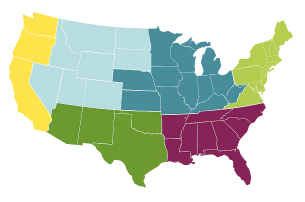
How do we use your location?
Knowing your location helps us recommend plants that will thrive in your climate, based on your Growing Zone.
| Buy More, Save More | Bulk Discount |
|---|
* There is a 1 packet minimum required for this item.
Everybody knows "Common Milkweed," the tough leathery plant with the dusty lavender blooms that are favored by Monarch butterflies. Swamp Milkweed (Asclepias incarnata) is close to this variety, but much more elegant. The leaves are less coarse, and the plant is usually sort of willowy and tall. Best of all, the pink blooms also welcome monarchs and hummingbirds. As you can tell by the name, this wildflower prefers wet ground, but in full sun.
Native Range for Asclepias incarnata (Swamp Milkweed) - AL, AR, CO, CT, DC, DE, FL, GA, IA, ID, IL, IN, KS, KY, LA, MA, MD, ME, MI, MN, MO, MT, NC, ND, NE, NH, NJ, NM, NV, NY, OH, OK, PA, RI, SC, SD, TN, TX, UT, VA, VT, WI, WV, WY.
As soon as your order is placed you will receive a confirmation email. You will receive a second email the day your order ships telling you how it has been sent. Depending upon your order date, we may hold your shipment to combine it with other products on your order, if applicable. See our shipping information page for approximate ship dates and more detailed information. If you have any questions, please call Customer Service toll-free at (802) 227-7200 or contact us by email or chat.

Overall rating: 4.7272725 / 5 from 11 reviews.
Review topics: ["seeds","plants","milkweed","requirement"].
"I use this seed to fill in the back of my flower beds so that the Monarch Butterflies can lay their eggs! Last year I had 4 cocoons on the deck railing!"
"Following the guidance from American Meadows, we mass planted Milkweed into a large area ion a hill in our backyard. On numerous evenings we were totally amazed by the numbers of Monarchs, at least 50!"
"This is a great plant from a great company that produces viable seed with plenty of instructions. It always makes me sad when folks buy plants/seeds not knowing it's requirements + are disappointed it didn't grow. But it makes me mad they blame the seller. Folks, it is our responsibility to research + ask questions prior to buying. 40-50+ years ago, ignorance might have been an excuse due to no internet, local nurseries weren't as diversified, + there were just a few top mail order companies, etc. Today there are plant societies, garden clubs, botanical gardens, libraries, book stores + nurseries everywhere, not to mention the millions of online resources which include website for the above. There are societies for just about every plant you could want to grow. Type in (name of any plant) plus "society", + you will find both national and state + sometimes even local groups. Substitute "nursery" + you will find dozens of nurseries across the country; add your state + you can find those close by. In addition, the results may return dozens of blogs, groups, social media on growing such. Delve just a bit deeper - Add "university studies or papers", you will find university associated scientific papers, trials + fact sheets. Type in "commercial production" + name of plant - you will learn what the pros do; try "name of plant" + "propagation", or "disease", + "photos". The point I'm laboring on is there is no excuse for not learning + many times the failures are due to the individual not taking the time to research or ask for advice. Before buying, you need to know: type of soil or potting media, PH, water, light, cold hardiness zone, temperature, humidity, + nutrient requirements. A final tip: if fairly new to gardening or a particular plant, you might not want to depend on YouTube, chats + forums to learn. Once you have expert info down, you can discern what makes sense, or who knows what, then social media is a good thing. Knowledge is key to all pursuits."
"the seeds came quicker than i thought and they were already put through the cold stratification period. awesome product"
"great aid to helping monarchs"
"I started the seeds indoors, more than half sprouted, which from what I understand, is a good percentage for Milk Weed. The roots of this plant are very delicate and do not respond well to transplantation, so I kept them in Jiffy pots. When it was time to put them outside, I just tore off the bottom of the pot and buried the whole thing in a sunny spot. They are not flowering yet, but I expect this plant to do well."
"During winter 2014/2015 I sowed three different types of milkweed- Common, Swamp, and Butterflyweed. The Swamp Milkweed is far and away the easiest to get to germinate and transplant. With cold stratification I had good germination rates and the resulting seedlings have been potted up. It will soon be time for them to go into the garden. Very happy with these seeds."
"Attracts butterflies. Beatutiful."
"Most milkweed seeds need a period of cold to break their dormancy. Spring planted milkweed seeds will have a very low germination rate. To overcome this, scarify the seeds, i. e. put them in a plastic bag in damp (not wet) sand and keep them in the refrigerator (not freezer) for 6 weeks. Then plant outside or in pots. Tropical milkweeds do not need this."
"purchased 3 plants from AM, two came up, called they were out of it, but will send more in the spring! great company, great plant, if you love butterflies, this is the plant for you. . . keep it watered! and it will do fine. . I have it in my butterfly garden, and it's healthy and has had over 50 monarch caterpillars on it this year. . this is my first year with it. . mine was white, very pretty!"


