
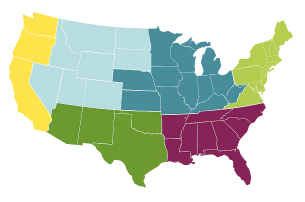
How do we use your location?
Knowing your location helps us recommend plants that will thrive in your climate, based on your Growing Zone.


The delivery of this product is either restricted by your state or we don't offer delivery to your location. Please see our Shipping FAQ for more info.
The delivery of this product is either restricted by your state or we don't offer delivery to your location. Please see our Shipping FAQ for more info.
| Buy More, Save More | Bulk Discount |
|---|
* There is a 1 packet minimum required for this item.
The Trillium Tribe, and why its so famous. The classic 4-inch thick botanical reference work, Hortus Third, tells us that there are about 30 species of Trillium worldwide, but the majority of the species are native to North America. A very few originate in Japan and Korea, none in Europe. This is one reason that our colonists were so taken with these woodland beauties when they arrived. They had simply never seen anything like them.
Trilliums, as the name implies have everything in 3s--three leaves, three petals, etc. And compared to the other spring flowers that bloom when winter is finally over in our cold climates, the Trilliums are the ones with large look-at-me flowers. They were famous with the Indians before colonization, and instantly the stars of spring bloom with the colonists.
Remember, when the colonists arrived, they arrived on our east coast which was totally wooded--big, primeval old growth forest, right down to the beaches. And under these cathedral-like trees were the woodland native flowers--almost all species the Europeans had never seen. Also, this is why almost all the native flowers of our east coast are woodland plants, not meadow wildflowers. Of this famous original group of woodland wildflowers, which includes the Lady Slippers, Mayflower, Hepatica and many more, the Trilliums reigned supreme.
For centuries the flowers were picked heavily, which is unfortunate since a picked trillium is a dead trillium. But it was the clearing of the forests for farming, a necessity for the colonists, that really devastated the woodland wildflowers. We like to wring our hands about paving for interstates and new condominium projects today, but we needn't. The damage was done long ago when our ancestors cleared the eastern forests for farming. Of course, there are relatively small habitats left, and in recent years, our forested area has been enlarging, and woodland wildflower habitat has been restored in many places.
In any case, this elegant class of flowers, the Trilliums, are now recognized as precious and special, although they are not officially endangered. In many areas, Trilliums are still very common.
Wildflower gardeners love them, and it is true that most of them are not difficult to grow or transplant, and if conditions are good, they thrive. However, it does help to know the facts.
Here's how they are propagated. Trilliums such as The Great White spread very slowly by underground root stocks, and the seed produced creates new plants even more slowly. From a planted seed, it takes approximately five to nine years for a Trillium grandiflorum plant (the Great White Trillium) to bloom. So when you see a massive drift of these in spring, you kinow youre looking at a bunch of plants that are at least a decade old, probably much older. These plants are not daisies!
And how do they propagate themselves? Well, T. grandiflorum is one of the wildflowers whose seeds are distributed by ants. Yes, ants--not birds or bees, or the wind, but ants. This is why the species creates large close drifts over the years. Plants are never very far apart, since ants don't travel far. So each clump of T. grandiflorum you see was planted where you see it by an ant. (They carry the seeds away when they fall from the plant because the ants enjoy the sticky covering each seed case has when it falls to the ground.)
That brings us to the basic rarity of the Trilliums. A big factor is that each flower produces only one seed case when it fades. (Everybody knows that most flowers--a daisy, for example, produces hundreds of loose seeds from each flower.) So even if the ants find the sticky seed case, and take it underground where the several seeds inside can grow, there simply aren't huge numbers of white trillium seeds being planted each year. Other trillium species have various propagation strategies, but all take years and years.
Now you have some idea of the value of these beautiful plants. They are an important part of American botanical history, and deserve a place of honor in every American wildflower garden.
Here are the best known species, with a little info on each:
Trillium grandiflorum, Great White Trillium. The provincial flower of Ontario, and quite common there and around the Great Lakes. Also the official wildflower of Ohio, T. grandiflorum is native over most of the east, from Canada to Georgia, especially in neutral or non-acid soils. Large white flowers fade to pink; plants form large drifts.
Trillium erectum, Red Trillium. Also called Wake Robin and Stinking Benjamin, the second because of the flowers unpleasant odor, said to be similar to rotting meat. Propagated by flies. Red to purple flowers; plants solitary in acid or alkaline woods. Native to the eastern forests from Canada to Georgia.
Trillium undulatum, Painted Trillium. Smaller than the Great White or Red, but with one of the most beautiful flowers--white with purplish/red centers. Must have highly acidic soil; common in pine woods. Native to forests from Canada to Georgia.
Trillium Catesbaei, Rosy Trillium or Catesby Trillium. One of the first Trilliums discovered and named for Mark Catesby, the famous early British plant explorer and artist. The Rosy Trillium has somewhat smallish blooms which nod below the leaves. It is native to the Southeast, where Catesby visited.
Trillium viride var luteum, Yellow Trillium. This unusual trillium has mottled leaves and lemon yellow blooms that hold their petals high and never really open. It is often said to have a lemon scent, and is native from Kentucky south to Florida.
Trillium ovatum, Coast Trillium. This is a famous western trillium, much like T. grandiflorum in the east. Flowers are white, fading to pink. It is native from British Columbia through coastal forests all the way to central California.
As soon as your order is placed you will receive a confirmation email. You will receive a second email the day your order ships telling you how it has been sent. Some perennials are shipped as potted plants, some as perennial roots packed in peat. The ‘Plant Information’ section describes how that item will ship. All perennials and fall-planted bulbs are packaged to withstand shipping and are fully-guaranteed. Please open upon receipt and follow the instructions included.
Perennials and fall-planted bulbs are shipped at the proper planting time for your Growing Zone. Perennial and fall-planted bulb orders will arrive separately from seeds. If your order requires more than one shipment and all items are shipping to the same address, there is no additional shipping charge. See our shipping information page for approximate ship dates and more detailed information. If you have any questions, please call Customer Service at (802) 227-7200 or contact us by email or chat.

Overall rating: 3.826087 / 5 from 23 reviews.
The Red Trillium, a native wildflower of the eastern United States, is known for its beautiful blooms and historical significance. It thrives in moist, shaded woodland areas and is part of the famous Trillium family, which includes several other species. Customers have shown satisfaction with the plant's growth and blooming, though opinions vary.
Review topics: ["look","buy","plants","trilliums","growing","babies","leaves","roots","bag"].
"Hard winter in MN--deep cold and no snow cover so I suspect it is the reason this did not survive."
"Two of three appeared after the winter, but neither flowered. I'm interested to see if they flower next year."
"Two of these came up in the spring, but neither flowered. I hope they do next year. "#sweepstakes"
"I planted some bareroot Red Trillium a year ago in a shaded border. Didn't see anything growing last year, but after a few warm days I just noticed some beautiful Trillium leaves! Looking forward to seeing it grow to its full beauty!"
"I have planted this red trillium in a big planter, in shade. It is still alive in Central Texas heat of 100+ degrees for weeks now. I don't have to water it more than once a week either. I am not disappointed yet, because it hasn't bloomed yet. I must have planted it in late 2022; and it is July 2023."
"Supplementing naturally occurring population."
"Ordered 9 trillium - 8 arrived in plastic bags packed in bone-dry peat. One bag contained only peat. Of the other 8, some were only hair-thin with no roots, the others were 7-8" stems curled like a pig's tail from being in the bags too long. Planted in well-draining mix, keep moist in bright shade. All died within days to a week. Contacted customer service - got told I "did not follow instructions on website" Complained again and got partial refund on product - nothing back for shipping. I feel the trilliums were bagged long before shipping and sat in a warehouse until they were almost dead. This season I successfully grew hundreds of plants from seeds and tubers - including others from American Meadows. Will not be customer in future - can't risk more bad product without decent support"
"Mine red trillium didn't come back up this year. Not sure why, since other plants around it are doing well. Disappointing, and a mystery."
"Scattered these among other trillium currently growing. Nothing ever came up. (didn't see any signs of hungry wildlife) Maybe they'll show up this coming spring."
"I planted three Wake Robin (red) trillium in a slightly raised box in our shaded glade last year (raised bed because after we'd cleared out the masses of bittersweet vine, there were still lots of roots in the ground) to replace the ones we loved in our old home ten miles away. I used Coast of Maine raised bed material along with a good healthy bag of top soil and crossed my fingers. This month we have three very healthy looking Wake Robin little plants coming up and spreading their leaves. The other shade woodland plants we got are also coming up (one blooming) already and looking healthy and happy. I'm very pleased! I think the setting and the fact that these are native to our area helps a lot. But I appreciate American Meadows making them available here on the other side the mountain than where we used to have them."


